Scheduling and priorisation
The following chaptes shows the flow and priority calculation of Slurm scheduling with the multifactor/fairtree priority plugin.
Slurm Scheduling Workflow
Each job goes through three to four stages: submission → priority calculation → main scheduler (by priority) → usually also the backfill scheduler as a "gap filler".
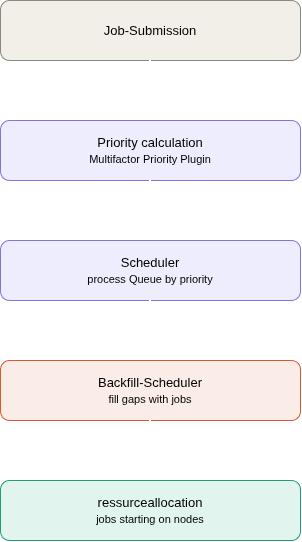
The overall priority of a job in the Multifactor plugin (which forms the basis for the main scheduler) is calculated as a weighted sum:
Priority = PriorityWeightAge       × F_age
         + PriorityWeightFairshare × F_fairshare
         + PriorityWeightJobSize   × F_jobsize
         + PriorityWeightPartition × F_partition
         + PriorityWeightQOS       × F_qos
         + Σ (TRESBillingWeight_i  × F_tres_i)
All factors F lie between 0 and 1. F_fairshare has the largest weight at UBT – it is derived from the Fair Tree algorithm.
Fair Tree: Calculating Fairshare
Fair Tree compares sibling nodes (accounts/users with the same parent node) at each level of the tree. For each node i at a given level:
S_i  = shares_i / Σ shares_siblings        (normalized share)
U_i  = usage_i  / Σ usage_siblings        (normalized usage)
LF_i = S_i / U_i                          (Level-Fairshare)
A high LF value means that, relative to its assigned share, the node has consumed comparatively little so far → resulting in a higher priority. The ranks are propagated from the root down to the leaf; the final F_fairshare is derived from the global rank position (F = (N − rank) / N), normalized to [0,1].
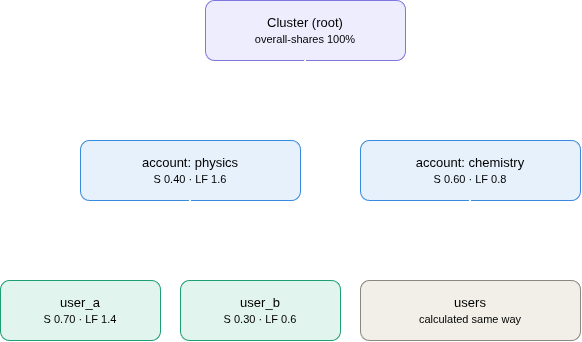
Example calculation: physik has 40% of the cluster shares, but has consumed only 25% of the normalized usage → LF = 0.40 / 0.25 = 1.6. chemie has 60% of the shares and 75% of the usage → LF = 0.60 / 0.75 = 0.8. Therefore, physik ranks higher – Slurm effectively "owes" it additional compute time. Within physik, the same comparison is then performed between user_a and user_b, independently of the ranking at the account level. This is the key principle of Fair Tree: comparisons are always made only between siblings, never across the entire tree. This prevents a large account from simply "pushing out" a small account.
Backfill Scheduling
Backfill allows lower-priority jobs to run ahead of higher-priority jobs, provided that doing so does not delay a higher-priority job that is already waiting.
The condition for job_low is:
start_low + walltime_low ≤ t_reserved(job_high)
AND enough free nodes are available immediately
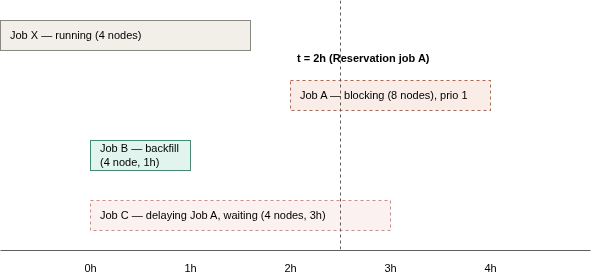
t_reserved is the time at which the blocked top-priority job A is allowed to start according to the backfill reservation. This is calculated based on the estimated remaining runtimes of currently running jobs.
Example (10-node cluster)
- Currently free: 6 nodes (Job X occupies 4). Job A (highest priority) requires 8 nodes → it cannot start immediately.
- Job X finishes at t = 2h → all 10 nodes will then be free → backfill reservation for Job A: t_reserved(A) = 2h.
- Job B (4 nodes, 1h walltime): 0h + 1h = 1h ≤ 2h ✓ and 4 ≤ 6 currently free nodes ✓ → Job B is started immediately via backfill without delaying Job A.
- Job C (4 nodes, 3h walltime): 0h + 3h = 3h > 2h ✗ → it would delay Job A → Job C remains in the queue, even though there are currently enough free nodes to run it.
Fair Tree determines who is next in line (priority), while backfill determines when someone else may temporarily be moved ahead without violating that ordering.
Settings @ UBT
The following priority weights are configured for the Fair Tree algorithm:
Priority = 1000  × F_age
         + 20000 × F_fairshare
         + 1     × F_jobsize
         + 4     × F_partition
         + 8     × F_qos
         + 0     (PriorityWeightTRES = null → term is omitted completely)
At UBT, the share assigned to a cluster clearly dominates the priority calculation. The share for each chair/department (account) is based on its contribution to the system, expressed in euros. Accounts that do not contribute financially are assigned a fictitious euro contribution. Users belonging to an account, or using resources under that account, inherit the account's share (share=parent).
Other important settings on the KeyLabHPC systems
- PriorityDecayHalfLife = 3-00:00:00: Previously accumulated usage loses half of its weight every 3 days (exponential decay).
- PriorityUsageResetPeriod = WEEKLY: Usage is completely reset once per week.
- PriorityMaxAge = 10-00:00:00: F_age stops increasing after 10 days.
- PriorityFlags = SMALL_RELATIVE_TO_TIME: F_jobsize is calculated relative to walltime × CPU rather than the number of nodes.
- bf_window = 1440: The backfill scheduler only plans reservations for the next 24 hours.